Why I stood naked in a Spanish square to protest bullfighting
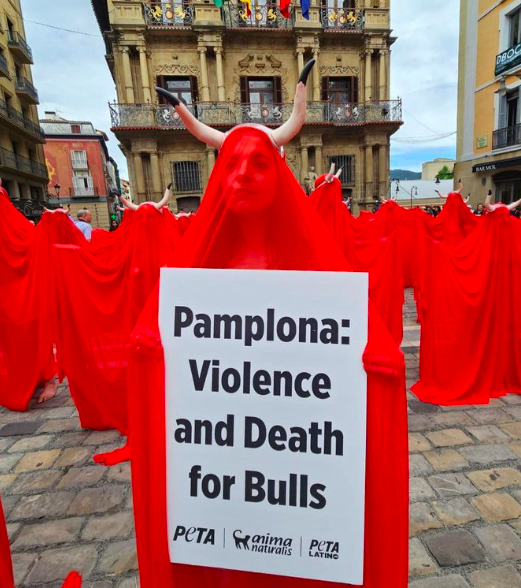
I have been in my current job at the UK entity of PETA - the world’s biggest animal rights organisation - for over eight years. Every year during this time, I’ve worked on one of our biggest yearly events: the big protest against the Running of the Bulls in Pamplona, Spain. Coordinated alongside Spanish animal protection group AnimaNaturalis, the protest involves dozens of people and takes place in Plaza Constitorial, Pamplona’s central square.
Gathering in eye-catching visuals, the activist aim to raise awareness of what happens during the Running of the Bulls, a fixture of the annual San Fermín Festival: 48 bulls are being confined before being released into the streets of Pamplona, being made to run alongside tourists who have come from across the world to attend the event. Terrified and confused, the animals slip and slide on the narrow streets, and the risk of injury is high to both runners and bulls (the difference being of course that the runners, some of whom are injured every year, are voluntary participants in the event). At the end of the run, the bulls are gathered in the bullring, where each of them will be taunted and tortured with spears for hours before their inevitable, violent death at the hands of humans.
Every year, I’ve seen colleagues and other activists take part in the protest. And this year, I was one of them.
Travelling to Pamplona felt like I was embarking on an adventure - but one that, through so many years of this campaign, I was somehow already familiar with. Sinking into my seat on the flight, I felt like any other time I’ve fastened my seat belt ahead of a two-and-a-half-hour Easyjet ride. But this time was different.
Landing in Biarritz, France, and heading towards the car rental where other colleagues were waiting, we were chatting away and passing the time, getting more worn out as the day darkened into night and the cars whizzed through France and entered Spain. It seemed so far off to just imagine that we’d be standing naked in a square in just a few hours.
The night was spent tossing and turning in my bed in the Airbnb in central Pamplona. The unexpected find of a cappuccino with soya milk at the small cafè downstairs the following morning was urgently needed. The caffeine kick jolted me awake as my colleague slid the rental car into a parking space close to where we were meeting the other activists. It was almost time.
I can’t say I’ve ever had a job where I had to nip into a restaurant bathroom to put on nipple covers before. But then again, working at PETA is not like any other job.
We were handed our surprisingly heavy sheer, red fabric and a pair of plastic horns before walking up towards the city centre. Undressing en masse, we helped each other drape the fabric over ourselves and fix the horns atop our heads - must have been quite a visual for the locals. I felt the cobblestones under my bare feet as I struggled to hold the fabric up. Wouldn’t have been a good look to stumble on it and fall on my face before the action even began.
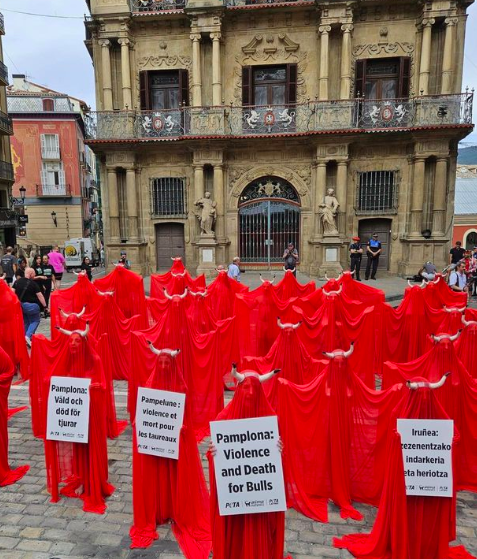
Holding a sign saying “Pamplona: Violence and Death for Bulls”, I took my place in the front row of the 40-person protest. Chanting “Tauromaquia abolición!” and “San Fermines sin crueldad”, we filled up the square with our presence. The words “sea of blood” that I’d typed out in a press release just a few weeks ago now became reality. The power of what we were creating rushed through me. Nothing beats the feeling of standing up for something you believe in - surrounded by people who wanted to make a change as passionately as I did, I felt empowered and whole. Our voices echoed for the spirits of those sentient, breathing, feeling individuals who would be mercilessly killed for the amusement of tourists in the coming days.
After it was all over, I was interviewed by journalists. “We are standing here today to remind tourists that at the end of each run, every bull will be stabbed to death in the bullring,” I said, the red veil still over my face. “It’s barbaric and unethical, and it must end.”
After the interviews, I was the last person of the group to get dressed and join the others for a massive group photo. Relaxing in a sunny park with some delicious vegan food after the mission was accomplished felt well deserved. The sun came out, and to any bystander we might have looked like any group of friends on holiday. As the waiter in the bar brought us our beers, there was nothing that stood out about us - nothing to reveal that not that long ago, we’d raised hell in the central square to attack one of the city’s proudest traditions. It was the best first sip of beer I’ve ever had.
A walk through the centre of Pamplona was a bitter reminder of how far we are from our goal. The beautiful architecture and Mediterranean vibes of the city were tarnished by bullfighting merchandise everywhere. Bulls printed on mugs, t-shirts and scarves. Stalls selling photos of the run. Bull-themed paraphernalia filling up shop windows. Seeing a children’s onesie printed with a bull among red splatters reminded me of the uphill climb still ahead of us. The bulls themselves? They rested in sunny enclosures, grazing and relaxing, while tourists queued up to gawk at them. They had no idea of the fate that awaited them.
Leaving Pamplona felt bittersweet. Among the swells of pride at what we had achieved - photos of the protest were all over international press - were the stings of not being able to save them, despite it all. For all our best efforts, each and every bull would still meet a brutal death in the coming days.
But the tide is indeed changing. Over 125 Spanish cities have banned bullfighting, as have cities in other countries. TV networks have implemented policies about showing bullfights. The majority of Spanish people want nothing to do with the bloodbaths, and first-time tourists are often horrified at what they find when they go. Many don’t return.
There is still a long way to go until bullfighting is relegated to history where it belongs. But we will get there. You don’t have to stand naked in a square to help - spreading the word in any way you can, and avoiding any “entertainment” that uses animals, will be a much-needed step along the way. A more compassionate future can be ours if we all stand up for it.
Photos by PETA